Cinta mengalahkan segalanya, tanpa cinta manusia akan mati rasa, kelu, kering, tanpa arti. Berbagi cinta akan membentuk manusia menjadi saling mengerti, menerima, dan berdampingan.
Rabu, 29 Februari 2012
Javan Eagle Habitat Loss
Environmental damage to nature on Java Island center part, potentially separating the Javan Hawk-Eagle (Spizaetus Bartelsi) population habitat in the western and eastern part of Java Island. This situation is feared threatened eagle population that only 325 pairs left.
Chairman of Indonesia Raptor, Rakhman Zaini said, with the loss of Javan hawk-eagle population corridor, those predator birds habitat will be more narrow.
This could lead to inbreeding occurrence that could potentially reduce the durability and quality of Javan hawk-eagle offspring.
About 75 percent of Javan hawk-eagle lives in the forest, so that animal is highly dependent on the forest. Javan hawk-eagle food is also typical, which is endemic animals such as mice.
Now, the forest in central Java more narrow. For example, forest area around Mount Merapi slopes that first inhabited by 12 pairs of Javan hawk-eagle is now only remaining five eagle.
Forests destruction on Mount Merapi slopes because of Merapi eruption in 2010 resulting hawks migratory.
Zaini explained, from about 311 kinds of hawks, there are 75 species that lives in Indonesia.
Javan Hawk-Eagle, with it unik form, topknot on the head, believed to be Garuda eagle that chosen by nation founders as Indonesia State Symbol.
Largest hunting
According to Zaini, at least there are three main factors causing Javan Hawk-eagle declined,which is wildlife illegal trading or selling, habitat destruction and pesticide use
Illegal trade/sell is the major cause for Javan Hawk-eagle declining (53 percent) followed by habitat destruction (42.3 percent) and the use of pesticides (4.7 percent).
Ownership of Javan hawk-eagle is still very high. In Yogyakarta alone there are about 40 different kinds of protected eagles, but maintained illegally..
Javan hawk-eagle population growth is very slow, only about 22 pairs for a year. Hawk population is quite slow because Javan hawk-eagle is only able to spawn one egg every two to three years.
Chairman of Yogyakarta Nature Conservation Foundation, Gusti Kanjeng Ratu Pembayun, appealed to illegal owner of Javan Hawk-eagle, for immediately returning the eagle to appropriate authorities. Within the next 20 years, extinction rate of Javan hawk-eagle is 20 percent reached.
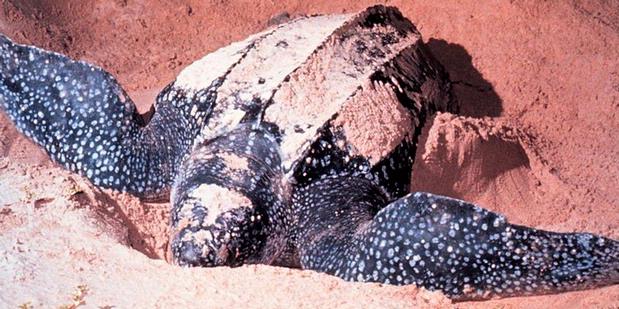
Endangered Aceh Sea Turtles
Coordinator of Sahabat Laut Indonesia, Ratno Sugito, said that sea turtle populations in Aceh Province waters is continue to decline.
Aceh Turtles are threatened to extinction due to rampant poaching by people and turtle eggs fail to staging.
Every year, Ratno said, on Wednesday (2/29/12), various types of sea turtle populations continue to decline between 20 to 30 percent. For that, Aceh Sea Turtles need attention from all elements, both society and government.
Ratno who is also Coordinator for Turtle Monitoring Network Team, said that before tsunami hit aceh in December 26, 2004, Aceh has large area for turtles egg laying. However, the area is reduced since the tsunami.
At present, with masive poaching, the existence of sea turtles in Aceh increasingly threatened.
Based on Kuala Network monitoring, there are three types of turtles that nesting in Pasie Lange, leatherback turtles, Green turtles and Hawksbill turtle.
About 20 years ago up to 10 turtle sires that lay eggs, but now only two to three sires. Ratno worried, for next 5-10 years that area will not be visited by sea turtles again.
Currently, there are seven species of sea turtles in Indonesian waters territorial, leatherback turtle (Dermochelys coriacea), Green Turtle (Chelonia mydas), Flatt Turtle (Natator depressus), Hawksbill Turtle(Eretmochelys imbricata), Jar Turtle (Caretta Caretta) and Dark/Pseudo Scales Turtle (Lepidochelys Olivacea).
Ratno urge to importance need for stoping masive turtles poaching and turtle eggs, to maintain the existence of these animals.
Selasa, 28 Februari 2012
EU Ask Indonesian Palm Oil Industry Noticed Environmental Issue
The European Union (EU) expecting Indonesian palm oil industry can pay attention to handle environmental problems.
This expectation is also supported by businessmen who are members in Indonesian Commerce and Industry Chamber (Kadin).
EU Ambassador to Indonesia, Julian Wilson, at Agri-Business Sustainable Palm Oil, in Jakarta, Wednesday (29/02/2012), said that CPO (crude palm oil) is a major industry for Indonesia. Europeans also like palm oil products, and one of Indonesia's largest market.
But Europe recognize there are environmental impacts from this industry. So EU hope the industry grow at the same time can handle environmental issues.
He heard, there is a company engaged in palm oil industry who have made methane capture from palm oil processing. The result is companies can save on energy cost while reducing greenhouse emissions.
Julian hope that Indonesian CPO industry able to multiply these examples, then greening their industry while maintaining their profitability.
Meanwhile, Vice Chairman Environment and Climate Change of Indonesian Kadin, Shinta Kamdani, said the business community could see a great opportunity from green investments.
Commerce and Industry Chamber, she added, welcomed government to support business people in Indonesia for made that transition.
Greenhouse Emissions Worsening in North Sumatra
Over 2.2 million units motor vehicles in North Sumatra (Sumut) Province, is the biggest contributor to greenhouse gas emissions which contribute to environmental pollution in that province.
Head of North Sumatra Enviromental Agency (BLH), Hidayati, in Medan, Tuesday (28/2/12), said that in addition to 2,284,404 motor vehicles, the presence of 1,600 industrial activities and 498 land fires contributed to worsening North Sumatra environmental condition.
Similarly, the existence of domestic waste is estimated at 7,800 tons a day. According to him, with population about 13 million people in North Sumatra, produce 0.6 kilogram garbage per person a day.
In addition, the presence of 1.7 million hectares of palm oil plantations in North Sumatra is estimated potentially produce 8.7 billion tons of substance that equivalent with carbon dioxide (CO2) a year.
Nationally, it is estimated dust particles will be increased up to 20 times in 2018 if nothing is done to change fundamental existence of greenhouse gas emissions.
North Sumatra it self, said Hidayati, implementing a number of policies, including in increasing surface water quality in Asahan River, Deli River, and Belawan River. Ecosystem consevation on Toba Lake, as well as East Coast and West Coast.
Langganan:
Postingan (Atom)